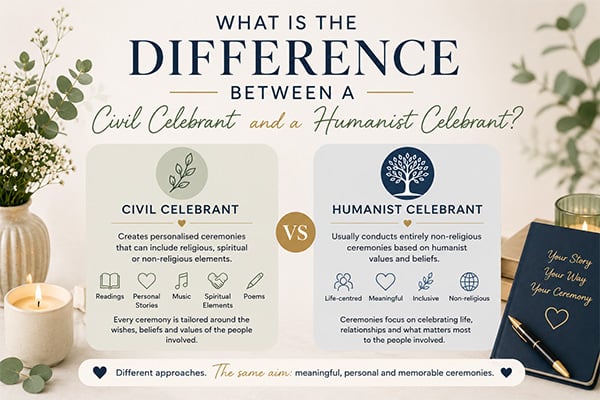
What Is the difference between a civil celebrant and a humanist celebrant?
Explore the difference between a Civil Celebrant and a Humanist Celebrant to choose the right ceremony for your needs.
Est. In 2023.

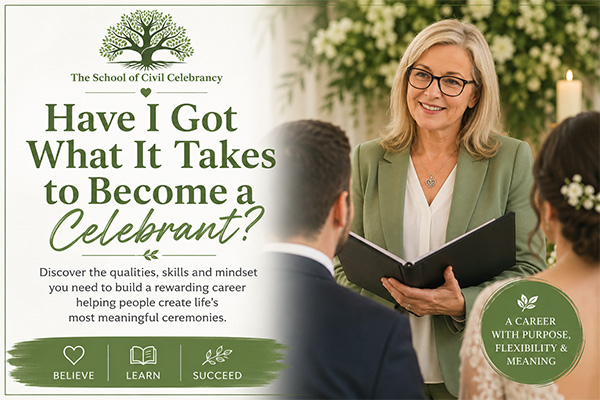
There comes a point in many people’s lives when they begin to wonder whether there is something more meaningful they could be doing. For some, that moment arrives after years in the same career. For others, it follows redundancy, retirement or a significant life event that changes their perspective. Increasingly, those people discover the profession of celebrancy and begin asking themselves an important question: Have I got what it takes to become a celebrant?
As Principal of The School of Civil Celebrancy, it is a question I hear almost every day. People often contact me because they have attended a beautiful funeral or a personalised wedding ceremony and have been inspired by the role the celebrant played. They tell me they enjoy working with people, that they want a career with purpose, or that they are looking for something that allows them to make a genuine difference in the lives of others. Almost without exception, however, those conversations are followed by a list of reasons why they believe they might not be suitable.
Some worry they are too old to start again. Others tell me they have never spoken in front of a large audience. Many are convinced they could never write a ceremony, while others quietly admit they lack confidence or doubt their own abilities. Having trained celebrants for many years, I can honestly say that these concerns are completely normal. In fact, I often find that the people who question whether they are good enough are the very people who go on to become thoughtful, compassionate and highly respected celebrants.
One of the greatest misconceptions about celebrancy is that you need to arrive with all the skills already in place. People imagine that successful celebrants must be natural performers, gifted writers or individuals who have spent years working in the funeral profession or the wedding industry. The reality is very different. While there are practical skills every celebrant needs to learn, those skills can be taught. What matters far more is your character, your willingness to learn and your genuine desire to help people through some of the most important moments of their lives.
Throughout this guide, I want to share what I have learned from my own experience as both a practising celebrant and someone who has trained learners from a wide variety of backgrounds. My hope is that by the end of this article you will have a much clearer understanding of what the role really involves, the qualities that make a great celebrant and whether this could be the rewarding career you have been searching for.
There Is No Such Thing as a Typical Celebrant
If I could change one misunderstanding about celebrancy, it would be the idea that there is a particular type of person who succeeds. Over the years I have met hundreds of celebrants, and if there is one thing they have taught me, it is that there is no such thing as a “typical” celebrant.
At The School of Civil Celebrancy, we have welcomed learners from an incredibly diverse range of professions. Some have spent their careers in education, helping children and young people to reach their potential. Others have worked in healthcare, supporting patients and their families during difficult times. We have trained former police officers, members of the Armed Forces, retail managers, accountants, engineers, business owners, carers, hospitality professionals and people who have dedicated their working lives to customer service. We have also welcomed learners who retired from one successful career before deciding they wanted to spend the next chapter of their lives doing something with greater purpose.
What quickly becomes clear is that none of these people arrived because they had mastered ceremony writing or public speaking. They arrived because they wanted to make a positive difference. Their previous careers had given them different experiences, different skills and different perspectives, but each brought something valuable into celebrancy. A teacher might already be comfortable speaking in front of groups, while a nurse often possesses exceptional compassion and empathy. Someone from the emergency services may remain calm under pressure, and a retail manager might have excellent communication and organisational skills. Every background offers strengths that can be developed into an outstanding celebrancy career.
Families and couples are not looking for somebody who fits a particular mould. They are not searching for the loudest voice in the room or someone who performs for attention. What they value most is authenticity. They want somebody who listens carefully, understands their story and creates a ceremony that genuinely reflects the people they love. The most memorable ceremonies are rarely those delivered with theatrical flair. Instead, they are the ceremonies where people leave feeling that they have been understood, respected and represented with care.
This is one of the reasons I enjoy training celebrants so much. Every learner develops their own style. Some are naturally humorous, while others have a calm and gentle approach. Some write with warmth and emotion, while others excel at telling stories with quiet confidence. There is room within celebrancy for different personalities because no two families, couples or ceremonies are ever the same.
Whenever somebody enquires about one of our courses, I can almost predict how the conversation will unfold. After discussing the role itself, they will usually pause before saying something like, “I’m not sure I’d be good enough.”
That sentence has probably been spoken to me hundreds of times.
It is often followed by comments such as, “I’ve never written anything like this before,” “I hate speaking in public,” or “I don’t think I’m confident enough.” Some worry about their age, while others believe they should have previous experience before they even consider training. These concerns are understandable because changing careers can feel like stepping into the unknown. It is perfectly natural to question yourself when you are considering something so different from what you have done before.
Interestingly, I have noticed that the people who express these concerns are often those who appreciate the responsibility that comes with becoming a celebrant. They understand that leading a funeral or a wedding is not simply about standing at the front and reading words from a page. It is about earning the trust of complete strangers and helping them through some of life’s most significant moments. That sense of responsibility is not a weakness. In many ways, it is one of the qualities that helps people become excellent celebrants.
Confidence is something that develops gradually. It grows as your knowledge increases, your experience expands and you begin to trust the skills you have developed. Every experienced celebrant remembers conducting their first ceremony. I certainly remember mine. There is a natural sense of responsibility because you want everything to be just right for the family or couple you are supporting. Over time, however, preparation becomes second nature, your confidence grows and you begin to focus less on yourself and more on the people in front of you.
The important thing to remember is that confidence is rarely the starting point. More often than not, it is the result of learning, practising and gaining experience. No training provider should expect you to arrive as the finished article. Their role is to help you become one.
One of the most reassuring things I tell prospective learners is that you are not expected to arrive at your training already knowing how to be a celebrant. That is the whole purpose of undertaking quality training. Nobody expects a driving instructor to teach someone who can already drive, and the same principle applies here. Professional celebrant training exists to equip you with the knowledge, practical skills and confidence needed to conduct meaningful ceremonies. What you bring with you is your personality, your life experience and your willingness to learn. Everything else develops over time.
Perhaps the greatest surprise for many new learners is discovering just how varied the role of a celebrant really is. People often imagine that the job begins when you stand in front of family and friends to conduct a ceremony. In reality, that moment is simply the final stage of a much longer process. Behind every successful funeral, wedding or naming ceremony are hours of careful preparation, thoughtful conversations, research, writing and planning. The ceremony itself may last only thirty or forty minutes, but it represents the culmination of many hours spent ensuring every detail feels personal, respectful and authentic.
One of the first skills you begin to develop is learning how to have meaningful conversations. At first glance that might sound straightforward because most of us speak to people every day. However, interviewing a bereaved family or a couple planning their wedding is very different from having an ordinary conversation. A celebrant learns how to ask thoughtful questions that encourage people to share memories, emotions and stories that truly capture the life of the person who has died or the relationship being celebrated. Just as importantly, you learn when not to speak. Some of the most meaningful moments happen during a quiet pause when somebody suddenly remembers a story they had almost forgotten or feels able to share something deeply personal.
Listening, in my opinion, is one of the greatest skills a celebrant can ever develop. It is often overlooked because people naturally focus on public speaking, yet every personalised ceremony begins long before a single word is written. The more carefully you listen, the richer your understanding becomes, and the easier it is to create a ceremony that genuinely reflects the people sitting in front of you. Families and couples rarely remember every sentence you wrote, but they almost always remember how well you listened. They remember feeling heard, understood and valued, and that experience is often just as important as the ceremony itself.
Writing is another skill that many people worry about before they begin training. It is probably one of the biggest concerns I hear from prospective learners. They tell me they are “not writers” or that they have never been particularly good at English. I always reassure them that celebrancy is not about producing award-winning literature. It is about writing in a way that sounds natural when spoken aloud. A good ceremony should never feel like somebody is reading an essay. Instead, it should feel like one person is telling another person’s story with warmth, sincerity and respect. That style of writing can absolutely be learned, and it becomes easier with every ceremony you create.
Over the years I have watched learners transform their confidence as writers. The first ceremony often feels daunting because everything is new. They naturally question every sentence they write and wonder whether it sounds right. As training progresses, something begins to change. They stop trying to write what they think a celebrant should sound like and begin developing their own authentic voice. That is when their ceremonies become more personal, more engaging and far more meaningful. In my experience, the very best celebrants are not those who use the most elaborate language. They are the ones who write honestly, simply and from the heart.
Public speaking is another area that understandably concerns many people. We often hear that speaking in public is one of the world’s greatest fears, so it is hardly surprising that prospective celebrants question whether they could ever stand in front of a full chapel or lead a wedding ceremony with confidence. The reality is that confidence grows through preparation rather than personality. Every experienced celebrant remembers their first ceremony. There will always be a sense of responsibility because every family deserves your very best. However, as your knowledge grows and you gain experience, those nerves gradually become confidence. You stop thinking about yourself and focus entirely on the people you are supporting. That shift makes all the difference.
Something I always encourage learners to remember is that families are not expecting perfection. They are not looking for a television presenter or a professional actor. They simply want someone who speaks naturally, treats them with kindness and delivers a ceremony that reflects the person they love. The same is true for weddings and naming ceremonies. Couples are not searching for somebody who performs for attention. They want someone who creates a warm atmosphere, guides the ceremony professionally and helps everyone feel comfortable. Authenticity will always leave a greater impression than performance.
One aspect of celebrancy that is sometimes overlooked is that most celebrants are self-employed. While conducting ceremonies is undoubtedly the heart of the profession, it is only one part of what you do. Behind every ceremony is a business that needs to be managed professionally. Understanding this from the outset helps you develop realistic expectations and gives you the best possible chance of building a successful career.
Running your own celebrancy business involves far more than simply waiting for the telephone to ring. You will need to respond promptly to enquiries, arrange meetings, manage your diary, prepare quotations and invoices, maintain accurate records and ensure your clients always know what to expect. You will also spend time updating your website, creating content for social media, networking with local professionals and continuing your own professional development. These tasks may not always be visible to families and couples, but they play an essential role in building a professional reputation.
One lesson I often share with new celebrants is that recommendations are rarely won through advertising alone. They are earned by consistently delivering an excellent service. Funeral directors recommend celebrants they trust because they know those celebrants will care for their families. Wedding venues recommend suppliers who are reliable, organised and easy to work with. Families recommend celebrants who made them feel supported during one of the most important days of their lives. Every email you send, every meeting you attend and every ceremony you conduct contributes to the reputation you are building.
Patience is also important. Like any self-employed profession, celebrancy takes time to establish. Very few people qualify on a Friday and find themselves fully booked on Monday morning. Building relationships, developing confidence and earning recommendations all happen gradually. While that can sometimes feel frustrating, it is also one of the reasons why good celebrants build such strong reputations. They understand that trust cannot be rushed. It is earned through professionalism, consistency and genuine care for the people they support.
For anyone considering this profession, I believe it is important to understand both the rewards and the responsibilities. Celebrancy is an incredibly fulfilling career, but it is also one that requires commitment. You will invest time in your training, continue learning throughout your career and devote many hours to supporting the people who place their trust in you. In return, you gain the privilege of helping families, couples and communities through some of life’s most significant moments. Few careers offer that level of purpose, and it is one of the reasons so many celebrants describe their work as far more than simply a job.
When I first became a celebrant, I naturally focused on learning the practical aspects of the profession. I wanted to write meaningful ceremonies, support families well and deliver every service with confidence and professionalism. Like every celebrant, I learned something new with every ceremony I conducted. However, becoming a trainer gave me a completely different perspective. Watching people arrive with little or no experience before developing into confident, compassionate professionals has taught me just as much as my own journey ever did.
Looking back over the years, I have noticed some interesting patterns. The learners who arrive believing they need to be perfect rarely become the strongest celebrants. Instead, it is usually the people who are prepared to listen, accept feedback and continually improve who build the most rewarding careers. They understand that every ceremony offers another opportunity to learn. They remain curious, ask thoughtful questions and never lose sight of the fact that every family and every couple deserves their absolute best.
One lesson I have learned repeatedly is that technical ability will only ever take you so far. Of course, you need to know how to structure a ceremony, interview clients and deliver a professional service, but those skills alone do not create exceptional celebrants. Families remember how you made them feel. They remember whether you listened with genuine interest, whether you treated their loved one with dignity and whether they felt supported throughout the process. Long after the words of the ceremony have faded, those feelings remain.
Another observation I have made is that life experience often becomes one of a celebrant’s greatest strengths. Some learners initially apologise because they believe they are “starting late”. They worry that changing careers in their forties, fifties or even sixties somehow puts them at a disadvantage. In reality, I have found quite the opposite. Years spent raising families, working with people, overcoming challenges or simply experiencing life’s ups and downs often provide the emotional maturity that allows celebrants to connect naturally with others. Compassion is shaped by experience, and that experience is something no training course can teach.
Perhaps the biggest lesson of all is that the best celebrants never stop learning. Even after many years of conducting ceremonies, I still reflect on every service. I still think about conversations I’ve had with families, different ways of telling a story or small improvements I can make. That willingness to keep developing is one of the reasons celebrancy remains such a rewarding profession. No two ceremonies are ever the same because no two lives are ever the same. Every family teaches you something new if you are prepared to listen.
If I could sit down with every person who is considering becoming a celebrant, there are a few things I would want them to understand before they begin their journey. These are not things you will necessarily find in a course handbook, but they are lessons that experience has taught me over many years.
The first is that you do not need to pretend to be someone you are not. New celebrants sometimes believe they need to develop a particular “celebrant voice” or adopt a style that they think people expect. In reality, families and couples are looking for authenticity. They want somebody who is approachable, genuine and comfortable in their own skin. Your personality is not something to hide; it is one of your greatest strengths. As your confidence grows, your own style will naturally develop, and that individuality is often what people remember.
I would also tell every new celebrant that listening will always be more valuable than speaking. It is easy to become focused on writing the perfect ceremony or delivering it flawlessly, but the real magic happens much earlier. It happens during the conversations you have with the people sitting in front of you. The more deeply you listen, the richer those conversations become, and the easier it is to create something that feels personal and authentic. Every memorable ceremony begins with somebody feeling heard.
Another lesson is that building a successful celebrancy business takes patience. We live in a world where people often expect instant results, but reputation simply does not work that way. It grows slowly through consistency, professionalism and trust. Every ceremony you conduct contributes to that reputation. Every family you support has the potential to recommend you to somebody else. Every funeral director, wedding venue or colleague you work alongside forms an impression of how you conduct yourself. Success is rarely built on one exceptional ceremony. It is built on delivering an excellent service every single time.
I would also encourage every learner not to compare themselves with other celebrants. It is very easy, particularly when you first qualify, to look at people who have been working for many years and wonder whether you will ever reach their level. The truth is that every experienced celebrant was once exactly where you are now. They all conducted a first ceremony. They all experienced nerves. They all made small mistakes and learned from them. The only difference is that they kept going. Your journey will be your own, and it is important to allow yourself the time and space to develop naturally.
Finally, I would remind every new celebrant why they chose this profession in the first place. It is easy to become distracted by websites, marketing, administration and the day-to-day demands of running a business. Those things matter, but they are not the reason most people become celebrants. People choose this profession because they want to help others. They want to create ceremonies that matter. They want to make a difference during some of life’s most significant moments. If you never lose sight of that purpose, it will shape every decision you make throughout your career.
After everything we have explored in this guide, you may still be asking yourself the same question you had when you first arrived on this page.
“Have I got what it takes to become a celebrant?”
While only you can answer that question, I hope you have realised that the answer is not determined by how confident you feel today, how much public speaking experience you have or whether you have ever written a ceremony before. Those are all skills that can be learned through professional training, practical experience and a commitment to continual improvement.
Instead, I believe the question is better asked in a different way.
Do you genuinely enjoy listening to people?
Do you care about helping others?
Can you treat every family and every couple with kindness, respect and compassion?
Are you willing to learn, accept feedback and continue developing throughout your career?
If your answer to those questions is yes, then you may already possess the qualities that matter most.
Celebrancy is not about delivering perfect performances. It is about serving people with professionalism, authenticity and empathy. It is about creating ceremonies that reflect real lives, real relationships and real emotions. It is a profession that carries responsibility, but it also offers enormous privilege. Few careers allow you to support people through moments that they will remember for the rest of their lives.
Having worked as both a practising celebrant and as Principal of The School of Civil Celebrancy, I can honestly say that some of the finest celebrants I have met are people who once believed they would never be good enough. They simply took the first step, committed themselves to learning and allowed their confidence to grow with experience.
If you are still wondering whether you have what it takes, perhaps the better question is not whether you are ready today.
Perhaps the better question is whether you are ready to begin.
If you are compassionate, enjoy working with people and are willing to learn, you already possess many of the qualities that make an excellent celebrant. Practical skills such as ceremony writing, public speaking and business management are all developed through training and experience.
No. Most people begin celebrant training with no previous experience of conducting ceremonies. Quality training is designed to teach you the practical skills while helping you build confidence through guided learning.
Absolutely not. Many celebrants begin their careers after changing professions or retiring from long-term employment. Life experience often becomes one of your greatest strengths because it helps you relate to the people you support.
Confidence develops over time. Families and couples are not looking for a polished performer. They are looking for somebody who speaks naturally, listens carefully and genuinely cares about creating a meaningful ceremony.
Yes. Dyslexia should never prevent somebody from becoming a celebrant. Many successful celebrants are dyslexic and develop excellent systems that allow them to write, organise and deliver ceremonies confidently. With the right training and support, dyslexia can become a strength rather than a barrier. please see my blog post on being a celebrant with Dyslexia.
For many people, celebrancy is one of the most rewarding professions imaginable. It combines meaningful work, creativity, flexibility and the opportunity to make a genuine difference in people’s lives while running your own business.
People often ask me what the best part of being a celebrant is.
Some expect me to talk about the flexibility of being self-employed or the satisfaction of running my own business. While those things certainly have their place, they are not what makes this profession so special.
For me, the greatest reward has always been the privilege of being invited into people’s lives at moments they will never forget.
When a family sits down with you to talk about someone they have loved and lost, they are placing an enormous amount of trust in you. They are inviting you into one of the most difficult periods of their lives and asking you to tell the story of someone who meant the world to them. That is never something I take for granted.
The same applies to weddings and naming ceremonies. Couples trust you to help them celebrate one of the happiest days of their lives, while parents ask you to welcome a new child into their family in a way that reflects their hopes, values and love. These are moments that cannot be repeated. They only happen once, and it is a privilege to be part of them.
Over the years, I have come to realise that the ceremony itself is only one part of what families and couples remember. They remember how they were treated. They remember whether they felt listened to, whether they felt understood and whether somebody genuinely cared about creating something that reflected their wishes.
That is why celebrancy is about so much more than standing at the front of a room and reading words from a page. It is about building trust, offering reassurance and creating an experience that people will carry with them for years to come.
I often receive messages from families weeks or even months after a funeral simply to say thank you. Sometimes they tell me the ceremony helped them begin the grieving process. Others say that hearing stories about their loved one brought smiles during an incredibly difficult day. Couples often write after their wedding to say that their guests commented on how personal the ceremony felt and how different it was from any wedding they had attended before.
Those are the moments that remind me why I chose this profession.
No amount of marketing or business success can ever replace the feeling of knowing that you helped somebody through one of the most significant days of their life.
Trust sits at the heart of everything we do as celebrants.
Before a family chooses you to conduct a funeral, they need confidence that you will care for their loved one’s story with dignity and respect. Before a couple ask you to officiate at their wedding, they need to believe that you understand their vision and can create a ceremony that reflects their personalities and relationship. Before parents invite you to lead a naming ceremony, they need to know that you will celebrate their child in a way that feels meaningful to them.
That trust is not built during the ceremony itself. It begins much earlier.
It starts with the way you answer the telephone. It grows through your emails, your meetings, your willingness to listen and the way you make people feel during every interaction. Professionalism is not simply about arriving on time or dressing smartly, although those things certainly matter. Professionalism is demonstrated through consistency, reliability and genuine care.
One of the lessons I try to share with every learner is that people rarely remember every word you say. They do, however, remember how you made them feel.
Did you put them at ease?
Did you take the time to understand their story?
Did they feel they could trust you?
Those questions are often far more important than whether every sentence in the ceremony was perfectly written.
When people think about success, they often measure it by numbers. They think about how many ceremonies somebody conducts, how busy their diary is or how much money they earn. While those things may be indicators of a successful business, they do not necessarily define a successful celebrant.
Over the years, I have met celebrants who conduct well over one hundred ceremonies each year, and I have met others who deliberately choose to work on a much smaller scale so they can balance celebrancy with family life or another career. Neither approach is right or wrong. Success looks different for every individual.
For some people, success means building a full-time celebrancy business that becomes their primary source of income. For others, it means conducting a handful of ceremonies each month because they simply enjoy making a difference in their local community. Some celebrants specialise in funerals, while others focus on weddings or naming ceremonies. Many enjoy working across all three.
The important thing is not comparing your journey with somebody else’s.
One of the wonderful things about celebrancy is that it allows you to build a career that reflects your own goals, values and lifestyle. There is no single definition of success, and there is certainly no race to become the busiest celebrant in the area.
Instead, I encourage learners to focus on building a reputation they can be proud of. If families recommend you because you cared, if funeral directors trust you because you are reliable, or if couples tell their friends that you made their wedding unforgettable, then you are building something far more valuable than numbers alone.
A good reputation is earned over many years, and once established, it becomes the strongest foundation any celebrant can have.
If you have read this far, there is a good chance you are genuinely considering becoming a celebrant.
Perhaps you are looking for a career with greater purpose. Perhaps you want to use your life experience to support others, or maybe you simply feel drawn towards work that allows you to make a meaningful difference.
Whatever has brought you here, I hope one message stands out above everything else.
You do not need to be perfect before you begin.
You do not need years of public speaking experience.
You do not need to be a professional writer.
You do not need to have all the answers.
What you do need is compassion, a willingness to learn and a genuine desire to help people.
For more information about our celebrancy training courses, including the NOCN Level 3 Diploma in Funeral Celebrancy, the NOCN Level 3 Diploma in Wedding and Naming Ceremonies, and the NOCN Level 3 Certificate in UK Celebrancy, please visit our course pages.
If you have any questions about celebrant training, qualifications or becoming a professional celebrant, please contact us. We are always happy to help, with honest advice.
Explore the difference between a Civil Celebrant and a Humanist Celebrant to choose the right ceremony for your needs.
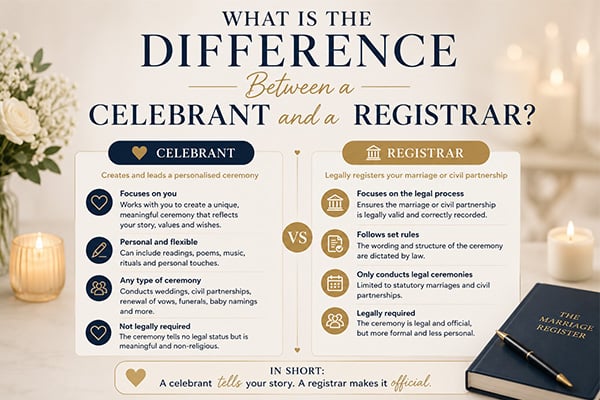
Uncover the difference between a celebrant and a registrar. Essential insights for those considering celebrant training.
Uncover how long does celebrant training take and understand what factors influence the completion time for your course.