What Is the difference between a celebrant and a registrar?
Uncover the difference between a celebrant and a registrar. Essential insights for those considering celebrant training.
Est. In 2023.

This is one of the most common questions people ask when they first start looking into celebrancy.
At first glance, celebrants and registrars can appear quite similar because both conduct ceremonies. But in reality, there are some very important differences between the two roles.
Understanding those differences helps couples and families choose the type of ceremony that feels right for them.
At The School of Civil Celebrancy, we often explain that neither role is “better” than the other. They are simply different approaches to ceremonies.
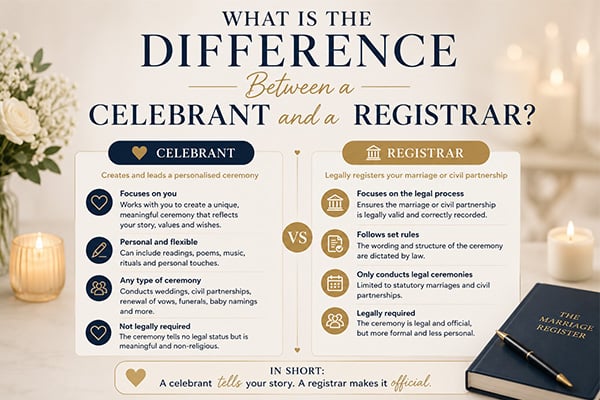
A registrar is employed by the local council and is legally authorised to register marriages, births, and deaths.
When it comes to weddings, registrars conduct the legal part of the marriage ceremony.
Registrar ceremonies are usually held in:
Because registrars work within legal regulations, there are certain rules they must follow regarding wording, structure, and content.
A celebrant creates and leads personalised ceremonies.
Rather than following a standard script, celebrant-led ceremonies are written around the couple, family, or individual.
This allows far greater flexibility and personalisation.
A celebrant-led ceremony may include:
No two ceremonies should ever feel exactly the same.
At present in most parts of England and Wales, celebrants cannot legally register marriages themselves. However the Wedding Reform Laws are being look at at he currenttime
This means couples usually complete the legal registration separately through a registrar, often in a simple legal appointment.
Their celebrant ceremony then becomes the meaningful and personal part of the wedding day.
This is one reason celebrant-led weddings have become increasingly popular.
Couples are no longer restricted by formal wording or rigid structures.
Within funerals, celebrants often offer far more flexibility than traditional formal services.
Families can choose:
Registrars provide an important legal role.
Celebrants provide a highly personal and flexible ceremonial role.
Many people now choose celebrant-led ceremonies because they want something that feels more human, individual, and reflective of real life.
And honestly, that personal connection often makes all the difference.
The main difference is the role they perform. A registrar is a local authority official who is authorised by law to conduct legally binding marriages and register births, deaths and marriages. A celebrant specialises in creating and delivering personalised ceremonies that reflect the wishes, values and personalities of the people involved. In England and Wales, most celebrant-led weddings are not currently legally binding, so couples usually complete the legal marriage separately with a registrar. Funeral and naming ceremonies conducted by celebrants are not legal processes and focus entirely on creating a meaningful and personal ceremony.
This depends on where the ceremony takes place. In England and Wales, celebrant-led wedding ceremonies are generally not legally binding, and couples must complete the legal marriage separately with a registrar. In Scotland and Northern Ireland, however, some celebrants are legally authorised to conduct marriages. It is always important to check the legal requirements that apply in the part of the UK where the ceremony will take place.
Many couples choose a celebrant because they want a ceremony that is completely personalised. A celebrant can spend time getting to know the couple, tell their story, include family traditions, involve friends and relatives, and create a ceremony that reflects their personalities. Couples often appreciate the flexibility to choose the location, wording, music and symbolic elements that are meaningful to them.
Registrars work hard to provide professional and memorable ceremonies within the legal framework they are required to follow. However, because they are conducting a legal marriage, there are rules and statutory wording that must be included. Celebrants generally have greater flexibility to personalise the content of a ceremony because they are not responsible for completing the legal marriage process.
No. Funeral ceremonies are normally conducted by celebrants, members of the clergy or other officiants. Registrars are responsible for registering deaths as part of the legal process but do not conduct funeral services. Funeral celebrants specialise in working with families to create personal and meaningful ceremonies that celebrate the life of the person who has died.
Naming ceremonies are usually conducted by celebrants. Registrars in some local authority areas may also offer naming ceremonies, but these vary between councils. Celebrant-led naming ceremonies are often highly personalised and can include promises, readings, music, symbolic acts and the involvement of family members or guideparents, creating a ceremony that reflects the family’s wishes.
Neither role is better than the other because they serve different purposes. Registrars perform an important legal function, ensuring marriages, births and deaths are properly recorded in accordance with the law. Celebrants specialise in creating personalised ceremonies that focus on the people involved and the stories they wish to share. The right choice depends entirely on the type of ceremony you want and the legal requirements that apply.
Yes, particularly for weddings in England and Wales. Many couples complete the legal marriage with a registrar before or after having a separate celebrant-led ceremony. Registrars and celebrants each fulfil different roles, and together they allow couples to meet the legal requirements while also enjoying a ceremony that is personal and meaningful.
A celebrant will usually spend considerable time getting to know the people they are working with. This may involve meetings, conversations, research, writing drafts, making revisions and carefully planning every aspect of the ceremony. Registrars, because of the legal nature of their role and the number of ceremonies they conduct, generally have less opportunity for this level of personal preparation.
The answer depends on what you are looking for. If you require a legally binding marriage in England or Wales, you will need a registrar to complete the legal formalities. If you want a ceremony that is written specifically for you, reflects your story and includes personal touches that are meaningful to you and your family, a celebrant may be the ideal choice. Many couples choose to have both, completing the legal marriage with a registrar and then celebrating with a personalised celebrant-led ceremony.
For more information about our celebrancy training courses, including the NOCN Level 3 Diploma in Funeral Celebrancy, the NOCN Level 3 Diploma in Wedding and Naming Ceremonies, and the NOCN Level 3 Certificate in UK Celebrancy, please visit our course pages.
If you have any questions about celebrant training, qualifications or becoming a professional celebrant, please contact us. We are always happy to help, with honest advice.
The main difference is the role they perform. A registrar is a local authority official who is authorised by law to conduct legally binding marriages and register births, deaths and marriages. A celebrant specialises in creating and delivering personalised ceremonies that reflect the wishes, values and personalities of the people involved. In England and Wales, most celebrant-led weddings are not currently legally binding, so couples usually complete the legal marriage separately with a registrar. Funeral and naming ceremonies conducted by celebrants are not legal processes and focus entirely on creating a meaningful and personal ceremony.
This depends on where the ceremony takes place. In England and Wales, celebrant-led wedding ceremonies are generally not legally binding, and couples must complete the legal marriage separately with a registrar. In Scotland and Northern Ireland, however, some celebrants are legally authorised to conduct marriages. It is always important to check the legal requirements that apply in the part of the UK where the ceremony will take place.
Many couples choose a celebrant because they want a ceremony that is completely personalised. A celebrant can spend time getting to know the couple, tell their story, include family traditions, involve friends and relatives, and create a ceremony that reflects their personalities. Couples often appreciate the flexibility to choose the location, wording, music and symbolic elements that are meaningful to them.
Registrars work hard to provide professional and memorable ceremonies within the legal framework they are required to follow. However, because they are conducting a legal marriage, there are rules and statutory wording that must be included. Celebrants generally have greater flexibility to personalise the content of a ceremony because they are not responsible for completing the legal marriage process.
No. Funeral ceremonies are normally conducted by celebrants, members of the clergy or other officiants. Registrars are responsible for registering deaths as part of the legal process but do not conduct funeral services. Funeral celebrants specialise in working with families to create personal and meaningful ceremonies that celebrate the life of the person who has died.
Naming ceremonies are usually conducted by celebrants. Registrars in some local authority areas may also offer naming ceremonies, but these vary between councils. Celebrant-led naming ceremonies are often highly personalised and can include promises, readings, music, symbolic acts and the involvement of family members or guideparents, creating a ceremony that reflects the family’s wishes.
Neither role is better than the other because they serve different purposes. Registrars perform an important legal function, ensuring marriages, births and deaths are properly recorded in accordance with the law. Celebrants specialise in creating personalised ceremonies that focus on the people involved and the stories they wish to share. The right choice depends entirely on the type of ceremony you want and the legal requirements that apply.
Yes, particularly for weddings in England and Wales. Many couples complete the legal marriage with a registrar before or after having a separate celebrant-led ceremony. Registrars and celebrants each fulfil different roles, and together they allow couples to meet the legal requirements while also enjoying a ceremony that is personal and meaningful.
A celebrant will usually spend considerable time getting to know the people they are working with. This may involve meetings, conversations, research, writing drafts, making revisions and carefully planning every aspect of the ceremony. Registrars, because of the legal nature of their role and the number of ceremonies they conduct, generally have less opportunity for this level of personal preparation.
The answer depends on what you are looking for. If you require a legally binding marriage in England or Wales, you will need a registrar to complete the legal formalities. If you want a ceremony that is written specifically for you, reflects your story and includes personal touches that are meaningful to you and your family, a celebrant may be the ideal choice. Many couples choose to have both, completing the legal marriage with a registrar and then celebrating with a personalised celebrant-led ceremony
Uncover the difference between a celebrant and a registrar. Essential insights for those considering celebrant training.
Uncover how long does celebrant training take and understand what factors influence the completion time for your course.
Explore the skills that make a great celebrant and find out how compassion and emotional understanding are essential.