Why RQF celebrant training matters
Understand why RQF Celebrant Training matters for ensuring emotional support and professional standards in meaningful ceremonies.
Est. In 2023.

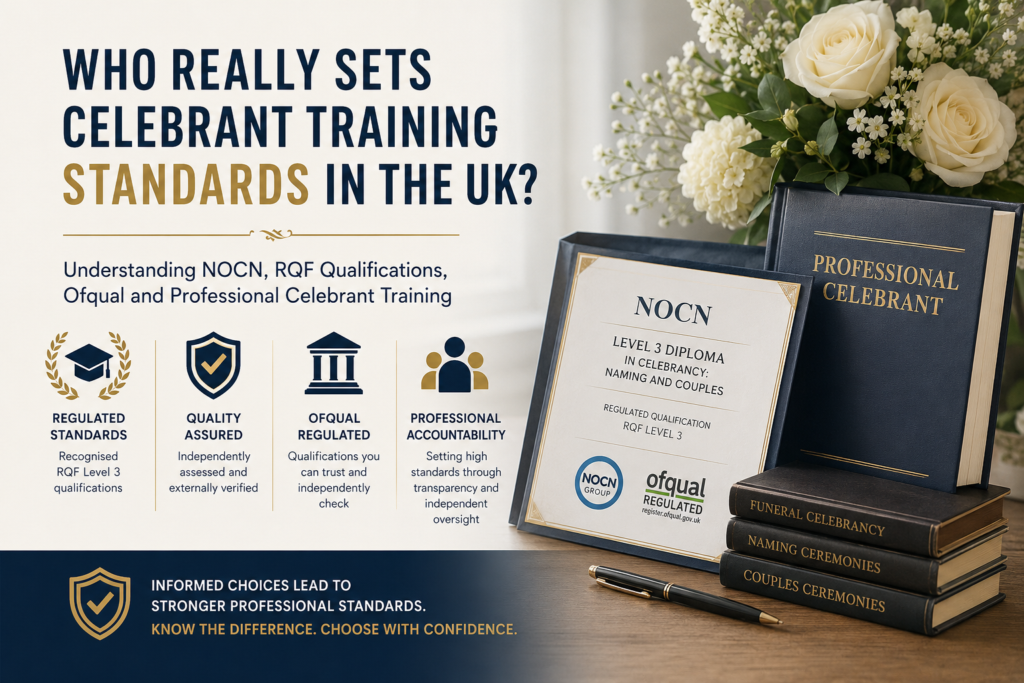
If you’re looking for celebrant training in the UK, you’ve probably come across training providers using phrases such as “setting the standard”, “raising professional standards”, “industry-leading training” or even the “gold standard” in celebrant training. These phrases can sound impressive, particularly to someone who is completely new to the profession, but they also raise an important question: who actually sets celebrant training standards in the UK?
At The School of Civil Celebrancy, we believe there is an important difference between maintaining high standards within a training organisation and claiming to set the educational standard for an entire profession. Every reputable training provider should aim to deliver excellent teaching, use knowledgeable and experienced tutors, provide appropriate learner support and continually review the quality of its training. However, those internal standards aren’t the same as a nationally recognised educational benchmark.
This isn’t about one celebrant training school criticising another, nor is it about suggesting that independently developed courses are automatically poor quality. There are experienced celebrants and trainers throughout the UK providing useful training and continuing professional development. This is about helping prospective learners understand what they’re purchasing, particularly when they may be investing significant amounts of money and many months of their lives in their professional education.
There is already an established system for regulated qualifications in England. Ofqual regulates qualifications, examinations and assessments, while regulated qualifications sit within the Regulated Qualifications Framework, commonly known as the RQF. This provides a recognised framework through which the level and size of qualifications can be understood.
Celebrancy itself isn’t currently a statutorily regulated profession, and this sometimes leads to the suggestion that there can be no recognised benchmark for celebrant training. However, whether celebrants are legally regulated and whether regulated celebrancy qualifications exist are two separate matters.
NOCN is an awarding organisation that offers regulated Level 3 qualifications specifically relating to civil celebrancy. These include the NOCN Level 3 Certificate in Civil Celebrancy in the UK, the NOCN Level 3 Diploma in Funeral Celebrancy, and the NOCN Level 3 Diploma in Celebrancy: Naming and Couples.
These qualifications haven’t been created by The School of Civil Celebrancy. They have defined units, learning outcomes, assessment criteria and qualification requirements that learners must meet. This provides an external educational benchmark rather than one determined solely by the training organisation delivering the course.
The term “Level 3” has a recognised meaning within the Regulated Qualifications Framework. It isn’t simply a description that should be attached to a course because a training provider considers its programme sufficiently detailed or challenging.
Prospective learners should therefore look carefully at phrases such as “Level 3 equivalent”, “equivalent to Level 3” or “training to Level 3 standard”. These descriptions don’t necessarily mean that the learner will receive an actual regulated RQF Level 3 qualification.
A regulated qualification has an identifiable awarding organisation, official qualification title, qualification level and qualification number. This information enables prospective learners to check the qualification independently rather than relying solely upon the description used by the organisation selling the training.
A training organisation can develop its own celebrant course, decide what subjects it wishes to teach, determine how long the programme lasts and decide what learners must complete before receiving the provider’s own certificate or diploma.
There is nothing inherently wrong with this type of training. Independently developed courses, specialist workshops, mentoring and continuing professional development can all contribute positively to someone’s professional development.
However, a certificate issued by an individual training provider isn’t automatically a regulated qualification. Similarly, terms such as “accredited”, “approved”, “certified”, “professional diploma” and “recognised” shouldn’t automatically be interpreted as meaning that a qualification is regulated by Ofqual or sits on the RQF.
This is why prospective learners should understand exactly what qualification or certificate they will receive before enrolling. The name given to a course isn’t what determines its regulated status.
There is another area that prospective learners should consider when comparing celebrant training, and that is training offered without a regulated qualification, recognised awarding organisation or meaningful external educational quality assurance.
Some celebrant training providers choose to create, deliver, assess and certificate their training entirely within their own organisation. They may not work towards a regulated qualification, they may not operate through a recognised awarding organisation, and there may be no independent external body reviewing the educational standard of the course or the assessment decisions being made.
That doesn’t automatically mean the training is poor, and it would be unfair to suggest that it does. An experienced celebrant may be capable of providing valuable training without delivering a regulated qualification. However, prospective learners should understand the important difference in accountability.
If the same organisation writes the course, decides what the standard should be, delivers the training, assesses the learner and awards its own certificate, the educational process may remain entirely within that organisation. There may be no independent awarding organisation checking whether assessment decisions are consistent, no external quality assurance of the qualification, and no regulated qualification standard against which the learner’s achievement can be independently measured.
For us, that raises a perfectly reasonable question: where is the independent educational accountability?
This is particularly important when a training provider makes strong claims about “setting the standard”, “professional standards” or being a leading authority in celebrant training. If an organisation claims to set a professional training standard, prospective learners are entitled to ask who independently verifies that standard and what external quality assurance sits behind it.
At The School of Civil Celebrancy, we don’t believe accountability should be something to fear. When delivering regulated qualifications, having assessors, internal quality assurance and external oversight creates additional work, additional administration and additional cost, but it also means that our educational processes aren’t based solely upon our own opinion of what constitutes an acceptable standard.
There are therefore several very different things that prospective learners may encounter when researching celebrant training. A provider may offer a regulated qualification through a recognised awarding organisation, it may be an approved centre while also offering its own non-regulated courses, it may offer training carrying some other form of external accreditation, or it may provide training and certification entirely under its own authority.
Those differences don’t tell you everything about the quality of the teaching, but they tell you something very important about the level of independent educational oversight and accountability behind it.
For someone investing substantial money in professional celebrant training, we believe that’s information worth knowing before they book.
One of the most important distinctions for prospective celebrants to understand is the meaning of NOCN Approved Centre status.
An organisation being an NOCN Approved Centre doesn’t mean that every course it offers is an NOCN qualification.
An approved centre may deliver regulated NOCN qualifications while also providing its own independently developed courses, workshops, CPD programmes or certificates. Those other courses don’t automatically become NOCN qualifications simply because the organisation delivering them is an NOCN Approved Centre.
Therefore, seeing an NOCN Approved Centre logo on a training provider’s website shouldn’t, by itself, be taken as confirmation that the particular course you’re considering is an NOCN regulated qualification.
The clearest way to establish this is to ask whether the specific course leads to an NOCN qualification and, if it does, ask for its full qualification title and qualification number.
For the established NOCN Level 3 celebrancy qualifications, these are the NOCN Level 3 Certificate in Civil Celebrancy in the UK, qualification number 601/2508/1; the NOCN Level 3 Diploma in Funeral Celebrancy, qualification number 601/1587/7; and the NOCN Level 3 Diploma in Celebrancy: Naming and Couples, qualification number 601/1586/5.
At The School of Civil Celebrancy, we actively encourage prospective learners to check this information. Being transparent about the qualification someone is undertaking should be a basic part of helping them make an informed decision.
One of the significant differences between a training provider’s own certificate and a regulated RQF qualification is the assessment and quality assurance structure that sits behind the qualification.
Learners undertaking a regulated qualification must produce evidence demonstrating that they’ve met defined assessment criteria. Their work is assessed by an appropriately qualified assessor, while the centre is also required to operate internal quality assurance processes to check the quality and consistency of assessment decisions.
An Internal Quality Assurer, commonly known as an IQA, provides oversight within the centre. The awarding organisation also carries out external quality assurance (EQA), providing scrutiny beyond the training provider itself.
This doesn’t mean that every piece of work submitted by every learner is individually remarked by an IQA and an External Quality Assurer. Quality assurance involves appropriate sampling, checking assessment decisions, reviewing systems and ensuring that the required standards are being applied consistently.
The result is a system in which the organisation delivering the training has responsibilities beyond simply deciding for itself whether a learner deserves a certificate.
The quality assurance behind regulated qualifications also requires a significant commitment from the training provider. Operating as an approved centre, registering learners, maintaining appropriate systems and records, engaging appropriately qualified assessors and internal quality assurers, undertaking standardisation and complying with external quality assurance requirements all involve time, administration and financial investment.
For a training provider, it may be simpler and less expensive to develop its own course, establish its own assessment arrangements and issue its own certificate. Some organisations may legitimately decide that they don’t want to undertake the additional costs and responsibilities associated with regulated qualifications.
That is a choice each training organisation is entitled to make. However, prospective learners should understand the difference between the two models before paying for their training.
At The School of Civil Celebrancy, we’ve chosen to accept the additional responsibilities and costs associated with delivering regulated qualifications because we believe independent quality assurance and external accountability have genuine value. A regulated qualification involves considerably more behind the scenes than teaching a course and issuing a certificate.
Explaining these differences isn’t scaremongering, nor is it about suggesting that every course outside the regulated qualifications framework is poor. It is about giving prospective learners factual information that allows them to make an informed choice.
Training to become a celebrant can represent a substantial financial and personal commitment. If somebody understands the difference between an independently created course and a regulated qualification and deliberately chooses the independent course, that is their decision. Equally, if somebody specifically wants a regulated Level 3 qualification, they should be able to establish clearly whether the course they’re purchasing leads to one.
Responsible training providers should be comfortable answering questions about awarding organisations, qualification levels, assessment arrangements and regulated status. Transparency benefits learners and helps strengthen confidence in professional celebrant training.
The question of celebrant training standards becomes particularly relevant when considering the proposed reform of wedding law in England and Wales. Discussions around the future role of independent celebrants naturally raise questions about professional competence, training and how appropriate standards might be demonstrated.
At the present time, the final requirements of any future wedding law reforms haven’t been determined. It would therefore be irresponsible for any training provider to guarantee that completing a particular qualification will automatically provide future legal status as a wedding celebrant.
However, if a formal educational benchmark is ultimately required, it will need to be something that can be objectively understood and independently verified. The NOCN Level 3 Diploma in Celebrancy: Naming and Couples is particularly relevant to this discussion because it is an RQF Level 3 regulated qualification with defined learning outcomes and assessment criteria relating specifically to naming and couples ceremonies.
At The School of Civil Celebrancy, we believe a regulated qualification of this nature provides a logical and credible benchmark when considering the future professional training requirements of wedding celebrants. We won’t speculate about what future legislation will require, but the existence of an established regulated qualification demonstrates that there is already a framework through which knowledge and competence can be formally assessed.
Professional standards are also being considered within the wider funeral profession. At present, we don’t know whether future regulation of the funeral sector will result in formal regulation, registration or qualification requirements for funeral celebrants, and it would be wrong to suggest that this will definitely happen.
Nevertheless, the discussion raises an important question. If somebody intends to work professionally as a funeral celebrant and a nationally regulated qualification specifically in Funeral Celebrancy is already available, why wouldn’t they consider studying for the formal regulated qualification?
The NOCN Level 3 Diploma in Funeral Celebrancy provides an RQF Level 3 qualification specifically focused on the knowledge and skills associated with funeral celebrancy. Learners must demonstrate through assessment that they’ve met the required learning outcomes and assessment criteria rather than simply attending training and receiving a certificate.
A qualification alone doesn’t make somebody an excellent funeral celebrant. Empathy, communication, writing ability, professional judgement, experience and continuing professional development all matter enormously. However, a regulated qualification provides a demonstrable educational foundation upon which those professional qualities can be developed.
If future funeral regulation eventually places additional expectations upon funeral celebrants, the profession will need to respond when those requirements become known. Until then, what we can say with certainty is that a regulated Level 3 qualification in Funeral Celebrancy is already available.
Regulated qualifications provide an educational framework, but the quality and professional experience of the people delivering the training also matter. Celebrancy is a practical profession involving real people at significant moments in their lives, and learners need to understand how their knowledge translates into professional practice.
A funeral celebrant may be trusted with deeply personal memories by a grieving family, while a wedding celebrant may be helping a couple turn years of shared history into a ceremony that genuinely reflects them. These responsibilities require knowledge, empathy, communication skills and professional judgement.
At The School of Civil Celebrancy, our approach is to combine the requirements of regulated qualifications with practical celebrancy experience. Learners need to understand the assessment criteria, but they also need tutors who can help them understand how that knowledge applies when they’re actually sitting with a family, writing a ceremony or standing in front of a congregation.
The regulated qualification provides the educational benchmark, while experienced tutors help learners develop the confidence and professional judgement needed to apply their learning effectively.
Training providers absolutely have a role in improving standards within celebrancy. They should invest in good teaching, appropriate assessment, learner support and the continuing development of their tutors. At The School of Civil Celebrancy, we expect high standards from ourselves and from the learners we support.
However, there is a difference between maintaining high standards and claiming to set the standard for an entire profession.
When nationally regulated celebrancy qualifications already exist, there is an established educational framework against which achievement can be assessed. Individual training providers can decide how they teach, how they support learners and what additional professional knowledge they bring to the learning experience, but they don’t need to invent their own definition of a national qualification standard.
This is why we believe discussions about standards should focus less on marketing slogans and more on what can genuinely be demonstrated.
Before booking a celebrant course, prospective learners should establish exactly what they’re purchasing. Ask what qualification or certificate you’ll receive, who awards it, whether it is regulated, what RQF level it sits at and, where applicable, what its official qualification number is.
If a course is described as “Level 3 equivalent”, ask whether it is actually a regulated RQF Level 3 qualification. If a training provider describes itself as an NOCN Approved Centre, ask whether the particular course you’re considering leads to an NOCN qualification. If the word “accredited” is used, ask who provides that accreditation and what it means.
These aren’t confrontational questions. They’re sensible questions that anyone investing in professional education has a right to ask, and reputable training providers should be able to answer them clearly.
Celebrancy continues to develop as a profession, and discussions around wedding law reform, standards within the funeral sector, professional recognition and appropriate training are likely to continue. Nobody can know with certainty what future regulation or legislation may eventually require.
What we can do now is distinguish between marketing claims and independently demonstrable educational standards.
Professional standards don’t mean every celebrant needs to work in exactly the same way. Individuality is one of the strengths of celebrancy. Two properly trained celebrants can have very different personalities, writing styles and approaches while both demonstrating professional competence.
A regulated qualification provides a foundation and an independently defined educational benchmark. The individual celebrant then brings their own personality, empathy, creativity, experience and professional approach to that foundation.
At The School of Civil Celebrancy, we don’t claim that we’ve invented the standard. Our responsibility is to maintain high standards in our own teaching, properly deliver the regulated qualifications we’re approved to offer, meet the assessment and quality assurance requirements placed upon us, and use our professional experience to prepare learners for the realities of working as celebrants.
For anyone considering professional celebrant training, there is one final question worth considering: if a nationally regulated qualification already exists for the profession you want to enter, why wouldn’t you consider taking it?
Before choosing your training, don’t simply look at the claims made by the provider. Understand what you’re purchasing, check the status of the qualification and make an informed decision.
Jon Matson-Higgins is Principal and Lead Tutor, Assessor and IQA at The School of Civil Celebrancy, an NOCN Approved Centre. Alongside training and assessing celebrants, Jon is a practising minister and celebrant, bringing practical experience of professional celebrancy into the School’s training and learner support.
For more information about our celebrancy training courses, including the NOCN Level 3 Diploma in Funeral Celebrancy, the NOCN Level 3 Diploma in Wedding and Naming Ceremonies, and the NOCN Level 3 Certificate in UK Celebrancy, please visit our course pages.
If you have any questions about celebrant training, qualifications or becoming a professional celebrant, please contact us. We are always happy to help, with honest advice.
Understand why RQF Celebrant Training matters for ensuring emotional support and professional standards in meaningful ceremonies.
Learn about self-regulation in celebrancy and the importance of professional standards in supporting emotional life events.
Explore the question: Is celebrancy regulated in the UK? Learn why proper training is essential for celebrants’ professionalism.